返回「114 學年度臺灣大學轉學生招生考試」題庫

114 學年度臺灣大學轉學生招生考試|全部題目+答案+詳解(第 2 頁)

國文、英文、普通物理學(A)、微積分(B) 歷屆試題

共 81 題

🚀 到「114 學年度臺灣大學轉學生招生考試」線上刷題(免費)所有公開題庫

英文

Impressionism emerged in France during the late 19th century as the first modern art movement, challenging traditional artistic norms. Pioneering artists such as Claude Monet and Edgar Degas, along with their contemporaries, faced rejection from the Salon, the official state-sponsored exhibition. In response, they organized their own independent exhibition in Paris in 1874, marking the beginning of a revolutionary approach to painting. Their works were distinguished by vibrant colors, an emphasis on light, unconventional subject matter, and thick brushwork.

Unlike previous art movements that favored muted tones and dark backgrounds, Impressionists embraced bright hues such as red, green, yellow, and orange. Their fascination with the interplay of light and color led them to paint outdoors, capturing fleeting moments in nature. Monet, for instance, famously painted the same scene multiple times at different hours to document the shifting effects of light.

The subjects of Impressionist paintings reflected their everyday surroundings. While the Salon favored historical, biblical, and mythological themes, Impressionists focused on rural landscapes, gardens, and riverbanks. They also depicted urban life, portraying bustling Parisian streets and the growing industrialization of the era. Their preference for painting outdoors influenced their choice of smaller canvases, allowing them to work directly from observation rather than relying on studio sketches.

Due to the limited time available before light conditions changed, Impressionists developed a distinctive style characterized by thick, sketch-like brushstrokes. Unlike the finely detailed figures of traditional art, their works deliberately avoided precision, favoring spontaneity and movement. Critics initially dismissed their paintings as lacking refinement, with art critic Louis Leroy coining the term “Impressionism” in a satirical review of Monet's work. Despite early skepticism, the movement gained recognition for its innovative approach.

Today, Impressionist paintings are celebrated worldwide, exhibited in prestigious museums, and sold for millions at auction. Their groundbreaking techniques and artistic vision have profoundly influenced modern art, shaping the way artists perceive and represent the world around them. Impressionism's legacy endures, proving that artistic rebellion can redefine the boundaries of creativity.

What does the word “legacy” most closely refer to?
  1. Wealth or property inherited from someone after their death.
  2. An achievement left behind for future generations.
  3. A person's reputation during their lifetime.
  4. An unexpected event or surprise.
提示
末段 Impressionism's legacy endures 指印象派『流傳後世的影響』,由此推 legacy 的字義。
參考答案

正解:B

詳解
A. 『某人死後繼承的財產』是 legacy 的另一狹義(遺產),但與本文『藝術影響流傳後世』的語境不符。
B. 正解:在文中 legacy 指留給後世的成就與影響(影響現代藝術、流傳至今),即『留給後代的成就』。
C. 『某人在世時的名聲』與『流傳後世』的時間範圍不符。
D. 『出乎意料的事件』與 legacy 無關。

普通物理學(A)

Consider the situation shown in the figure, where a baseball player slides to a stop on level ground. Using energy considerations, calculate the distance the 65.0-kg baseball player slides, given that his initial speed is 6.00 m/s and the force of friction against him is a constant 450 N.
  1. 0.6 m
  2. 1.6 m
  3. 2.6 m
  4. 3.6 m
  5. 4.6 m
提示
動能全被摩擦力做負功消耗。用 ½mv² = F·d 解出滑行距離 d。
參考答案

正解:C

詳解
A. 錯。0.6 m 遠小於正解,數量級不符。
B. 錯。1.6 m 為誘答,未正確代入數值。
C. 對。能量守恆:½mv² = F·d,故 d = mv²/(2F) = 65×6.00²/(2×450) = 2340/900 ≈ 2.6 m。
D. 錯。3.6 m 為誘答。
E. 錯。4.6 m 為誘答。
The Moon orbits the Earth each 27.3 days and it has an average distance of 3.84×10⁸ m from the center of Earth. Calculate the period of an artificial satellite orbiting at an average altitude of 1500 km above Earth's surface. The radius of Earth is 6380 km.
  1. 0.57 hr
  2. 1.9 hr
  3. 5.7 hr
  4. 19 hr
  5. 57 hr
提示
Kepler's third law says T² is proportional to the cube of the orbital radius (measured from Earth's center). Scale the Moon's known period down to the satellite's much smaller orbit.
參考答案

正解:B

詳解
A. (A) 0.57 hr — incorrect. Too short; this is roughly a factor of 10 below the correct value and not consistent with the radius ratio.
B. (B) 1.9 hr — correct. The satellite's orbital radius is R+altitude = 6380+1500 = 7880 km = 7.88×10⁶ m. By Kepler's third law T_sat = T_Moon × (r_sat/r_Moon)^(3/2) = 655.2 hr × (7.88×10⁶/3.84×10⁸)^(3/2) ≈ 655.2 × (0.02052)^(1.5) ≈ 1.9 hr — the familiar ~90 min low-Earth-orbit period.
C. (C) 5.7 hr — incorrect. This overestimates the period; it does not follow from the 3/2-power scaling of the radius ratio.
D. (D) 19 hr — incorrect. Far too long for a low orbit just above the surface; a satellite this close orbits in roughly 90 minutes.
E. (E) 57 hr — incorrect. Grossly too long; this would correspond to an orbit much larger than the Moon's, the opposite of the situation.
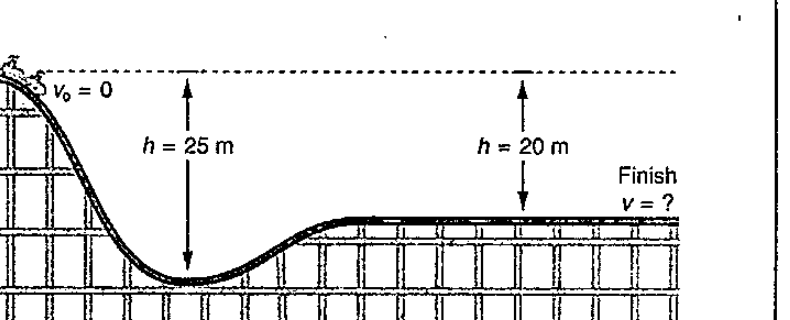
What is the final speed of the roller coaster shown in the figure if it starts from rest at the top of the 20.0 m hill and work done by frictional forces is negligible? The gravitational acceleration on Earth's surface is 9.8 m s-2.
  1. 2.4 m/s
  2. 4.9 m/s
  3. 9.8 m/s
  4. 19.8 m/s
  5. 29.4 m/s
提示
With no friction, mechanical energy is conserved, so the final speed depends only on the net vertical drop from the start to the finish — not on the dips along the way.
參考答案

正解:D

詳解
A. (A) 2.4 m/s — incorrect. Far too small; this is not consistent with a 20 m drop.
B. (B) 4.9 m/s — incorrect. This is numerically g/2, a sign of plugging numbers into the wrong relation rather than v = √(2gΔh).
C. (C) 9.8 m/s — incorrect. This equals g; it is a units confusion, not a speed derived from energy conservation.
D. (D) 19.8 m/s — correct. The coaster starts at rest at the top and ends at the finish, which the figure marks as h = 20 m below the start line (the 25 m is just the depth of the intermediate valley and does not matter when there is no friction). Energy conservation: ½v² = gΔh, so v = √(2 × 9.8 × 20) = √392 ≈ 19.8 m/s.
E. (E) 29.4 m/s — incorrect. Too large; this would require a drop of about 44 m, larger than the actual net descent.
The escape velocity (minimum velocity to escape the Earth's gravitational potential) for a 100-kg object on Earth is about 11 km/s. What is the escape velocity of a 50-kg object on the surface of Earth?
  1. 11 km/s
  2. 22 km/s
  3. 5.5 km/s
  4. 44 km/s
  5. 2.75 km/s
提示
Write the escape-velocity formula from energy conservation and notice which quantities it actually contains. Does the mass of the escaping object appear?
參考答案

正解:A

詳解
A. (A) 11 km/s — correct. Escape velocity comes from ½mv² = GMm/R, and the object's mass m cancels: v_esc = √(2GM/R). It depends only on the planet's mass and radius, so any object — 50 kg or 100 kg — escapes at the same ~11 km/s.
B. (B) 22 km/s — incorrect. This doubles the speed, as if escape velocity scaled with the object's mass; it does not.
C. (C) 5.5 km/s — incorrect. This halves the speed, the common mistake of assuming a lighter object escapes more easily. Mass cancels out.
D. (D) 44 km/s — incorrect. Quadrupling the speed has no physical basis; escape velocity is independent of the escaping mass.
E. (E) 2.75 km/s — incorrect. Dividing by four also wrongly assumes a dependence on the object's mass.
At what temperature would helium atoms have an rms speed enough to escape the Earth's gravitational potential? The proton mass is 1.67×10⁻²⁷ kg.
  1. 200 K
  2. 600 K
  3. 2×10³ K
  4. 6×10³ K
  5. 2×10⁴ K
提示
令氦原子的均方根速率等於地表逃逸速度,由 v_rms = √(3kT/m) 反解 T;注意氦原子質量是 4 個核子的質量。
參考答案

正解:E

詳解
A. 錯。200 K 太低。
B. 錯。600 K 仍太低。
C. 錯。2×10³ K 數量級偏低。
D. 錯。6×10³ K 為常見陷阱:若誤用單一質子質量(而非氦的 4 倍)會得到約 5×10³ K。
E. 對。令 v_rms = v_esc:T = m·v_esc²/(3k),氦原子質量 m = 4×1.67×10⁻²⁷ kg,v_esc ≈ 1.1×10⁴ m/s,得 T ≈ 1.95×10⁴ ≈ 2×10⁴ K。
Suppose an ice skater is spinning at 0.8 revolutions per second with her arms extended. She has a moment of inertia of 2.34 kg · m2 with her arms extended and of 0.363 kg · m2 with her arms close to her body (appropriate for a 60-kg skater). What is her angular velocity in revolutions per second after she pulls in her arms?
  1. 2.2 rev/s
  2. 3.2 rev/s
  3. 4.2 rev/s
  4. 5.2 rev/s
  5. 6.2 rev/s
提示
No external torque acts during the pull-in, so angular momentum L = Iω is conserved. The smaller moment of inertia must spin faster.
參考答案

正解:D

詳解
A. (A) 2.2 rev/s — incorrect. Too small; this would require the moment of inertia to barely change, contradicting the given values.
B. (B) 3.2 rev/s — incorrect. Still too small relative to the ratio I₁/I₂ ≈ 6.4.
C. (C) 4.2 rev/s — incorrect. Below the conserved-momentum result; does not match I₁ω₁ = I₂ω₂.
D. (D) 5.2 rev/s — correct. Conservation of angular momentum: I₁ω₁ = I₂ω₂, so ω₂ = (2.34/0.363) × 0.8 = 6.45 × 0.8 ≈ 5.16 ≈ 5.2 rev/s.
E. (E) 6.2 rev/s — incorrect. Too large; this overestimates the ratio of the moments of inertia.
A block of mass m oscillates at the end of a horizontal spring on a frictionless surface. At maximum extension, an identical block drops onto the top of the first block and sticks to it. How does the new period Tnew compare to the original period, T0?
  1. Tnew = 0.5 T0
  2. Tnew = T0
  3. Tnew = √2 T0
  4. Tnew = 2 T0
  5. Tnew = 3 T0
提示
The drop happens at maximum extension, where the oscillator's speed is momentarily zero. Think about what is conserved when the added block sticks, and how the period depends on the total mass.
參考答案

正解:C

詳解
A. (A) T_new = 0.5 T₀ — incorrect. Adding mass increases the period, not decreases it; period grows with √m.
B. (B) T_new = T₀ — incorrect. The total oscillating mass changes, so the period cannot stay the same.
C. (C) T_new = √2 T₀ — correct. At maximum extension the speed is zero, so the perfectly inelastic landing loses no kinetic energy and the spring constant is unchanged. The mass doubles (m → 2m). Since T = 2π√(m/k), T_new = 2π√(2m/k) = √2 · T₀.
D. (D) T_new = 2 T₀ — incorrect. This would require the mass to quadruple; it only doubles, so the factor is √2, not 2.
E. (E) T_new = 3 T₀ — incorrect. There is no factor of 3; the period scales with the square root of the mass ratio.
What is the ratio of the electrostatic force between an electron and proton separated by 0.53×10⁻¹⁰ m to the gravitational force between them? Their separation is the average separation in a hydrogen atom. The electron has a mass of 9.11×10⁻³¹ kg and a charge of 1.6×10⁻¹⁹ C. The gravitational constant is G = 6.67×10⁻¹¹ N m2 kg-2 and the Coulomb constant is k = 8.99×10⁹ N m2 C-2.
  1. 2.3×1049
  2. 2.3×10¹⁹
  3. 2.3×10⁹
  4. 2.3×1029
  5. 2.3×1039
提示
Both forces fall off as 1/r², so the separation cancels in the ratio. Compute kₑe² divided by G·mₑ·m_p — the answer is a famously huge pure number.
參考答案

正解:E

詳解
A. (A) 2.3×10⁴⁹ — incorrect. Ten orders of magnitude too large; the exponent does not work out to 49.
B. (B) 2.3×10¹⁹ — incorrect. This is closer to the electron–electron-style ratios people half-remember, but here one mass is the proton's, giving ~10³⁹.
C. (C) 2.3×10⁹ — incorrect. Far too small; this ignores how extraordinarily weak gravity is relative to the Coulomb force.
D. (D) 2.3×10²⁹ — incorrect. Ten orders of magnitude too small.
E. (E) 2.3×10³⁹ — correct. The r² cancels: ratio = kₑe²/(G mₑ m_p) = (8.99×10⁹ × (1.6×10⁻¹⁹)²)/(6.67×10⁻¹¹ × 9.11×10⁻³¹ × 1.67×10⁻²⁷) ≈ 2.3×10³⁹, the classic measure of how vastly weaker gravity is than electromagnetism.
For a uniform-density, spherical object with a mass M and a radius R, what is its gravitational potential energy?
  1. -3GM2/5R
  2. -GM2/5R
  3. -3GM2/4R
  4. -2GM2/3R
  5. -3GM2/3R
提示
This is the gravitational self-energy of a uniform solid sphere, found by integrating the work to assemble it shell by shell. The standard result carries a coefficient of 3/5 and is negative.
參考答案

正解:A

詳解
A. (A) -3GM²/5R — correct. Assembling a uniform sphere shell by shell and integrating gives the self-energy U = -(3/5)GM²/R. It is negative because gravity is attractive (bound system), and the 3/5 factor is the standard uniform-density result.
B. (B) -GM²/5R — incorrect. Missing the factor of 3 in the numerator from the integration.
C. (C) -3GM²/4R — incorrect. The denominator coefficient is wrong; the correct factor is 3/5, not 3/4.
D. (D) -2GM²/3R — incorrect. Neither the numerator nor denominator matches the uniform-sphere integral.
E. (E) -3GM²/3R — incorrect. This simplifies to -GM²/R, dropping the characteristic 3/5 coefficient.
Calculate the kinetic energy of a photon with a wavelength of 500 nm (KEph) and the kinetic energy of an electron that has the same momentum as the photon (KEe). What is the ratio of KEph / KEe? The Planck constant is h = 6.63×10⁻³⁴ kg m2 s-1.
  1. 4.1×10²
  2. 4.1×10³
  3. 4.1×10⁴
  4. 4.1×10⁵
  5. 4.1×10⁶
提示
The photon and electron share the same momentum p = h/λ. Compare a photon's energy (E = pc) with a non-relativistic electron's energy (E = p²/2m); the ratio reduces to 2mcλ/h.
參考答案

正解:D

詳解
A. (A) 4.1×10² — incorrect. Three orders of magnitude too small; check the powers of ten in 2mcλ/h.
B. (B) 4.1×10³ — incorrect. Two orders of magnitude too small.
C. (C) 4.1×10⁴ — incorrect. One order of magnitude too small.
D. (D) 4.1×10⁵ — correct. With equal momentum p = h/λ: KE_ph = pc and KE_e = p²/2m, so the ratio = pc/(p²/2m) = 2mc/p = 2mcλ/h = (2 × 9.11×10⁻³¹ × 3×10⁸ × 500×10⁻⁹)/6.63×10⁻³⁴ ≈ 4.1×10⁵. The photon carries far more energy than the equally-momentum electron.
E. (E) 4.1×10⁶ — incorrect. One order of magnitude too large.
How does the spectrum of a molecule differ from the spectrum of an atom?
  1. A molecule does not have spectral lines due to electron changing energy levels.
  2. A molecule has additional spectral lines due to changes in its rotational and vibrational energies.
  3. Molecules only have spectral lines at ultraviolet wavelengths.
  4. Most atoms only have spectral lines at infrared wavelengths.
  5. An atom has a wider range of spectral lines than molecules.
提示
Atoms store energy only in electronic transitions. Molecules have extra internal degrees of freedom that produce additional sets of lines and bands.
參考答案

正解:B

詳解
A. (A) — incorrect. Molecules still have electronic transitions just like atoms; they do not lose them.
B. (B) — correct. Beyond electronic transitions, molecules can also change their rotational and vibrational energy states. These quantized rotational and vibrational levels add many extra lines (and band structure), which atoms — having no such internal motions — lack.
C. (C) — incorrect. Molecular spectra are not confined to ultraviolet; rotational lines lie in the microwave/far-IR and vibrational lines in the infrared.
D. (D) — incorrect. Atomic spectral lines are not generally restricted to infrared; this is a false generalization.
E. (E) — incorrect. It is the reverse: molecules have a richer, wider set of lines than atoms because of the added rotational and vibrational structure.
What is the kinetic energy of an electron moving with a speed of v = 0.85c?
  1. 0.511 MeV
  2. 0.370 MeV
  3. 0.464 MeV
  4. 0.185 MeV
  5. 0.821 MeV
提示
At 0.85c you must use the relativistic kinetic energy KE = (γ − 1)mc², not ½mv². The electron's rest energy is 0.511 MeV.
參考答案

正解:C

詳解
A. (A) 0.511 MeV — incorrect. This is the electron's rest energy mc², not its kinetic energy.
B. (B) 0.370 MeV — incorrect. This underestimates γ; recompute γ = 1/√(1 − 0.85²) ≈ 1.898.
C. (C) 0.464 MeV — correct. Relativistic KE = (γ − 1)mc² with γ = 1/√(1 − 0.85²) = 1/√(0.2775) ≈ 1.898. So KE = (1.898 − 1) × 0.511 MeV ≈ 0.459 MeV ≈ 0.464 MeV.
D. (D) 0.185 MeV — incorrect. This is roughly the non-relativistic ½mv² result, which is invalid at 0.85c.
E. (E) 0.821 MeV — incorrect. This overestimates the kinetic energy; it does not match (γ − 1)mc² at v = 0.85c.
As a solid disk rolls over the top of a hill on a track, its speed is 80 cm/s. If friction is negligible, how fast is the disk moving when it is 18 cm below the top?
  1. 5.2 m/s
  2. 3.5 m/s
  3. 2.4 m/s
  4. 1.7 m/s
  5. 0.2 m/s
提示
A rolling disk stores energy in both translation and rotation, so its total kinetic energy is ¾mv². Also remember the disk already has speed at the top, and convert 18 cm and 80 cm/s to SI units.
參考答案

正解:D

詳解
A. (A) 5.2 m/s — incorrect. Far too fast; this ignores that a rolling body's KE is ¾mv² (extra rotational share) and that the drop is only 18 cm.
B. (B) 3.5 m/s — incorrect. Still too fast for an 18 cm drop with the rolling constraint.
C. (C) 2.4 m/s — incorrect. This is what you would get from a sliding (non-rolling) block using v = √(v₀² + 2gh); rolling reduces the speed gain.
D. (D) 1.7 m/s — correct. For a rolling solid disk, KE = ½mv² + ½Iω² = ¾mv². Energy conservation: ¾v² = ¾v₀² + gh, so v = √(v₀² + (4/3)gh) = √(0.8² + (4/3)(9.8)(0.18)) = √(0.64 + 2.35) ≈ 1.73 m/s.
E. (E) 0.2 m/s — incorrect. Far too slow; the disk speeds up as it descends, it cannot drop below its initial 0.8 m/s.
A point explosion with thermal energy E occurs at time t = 0, driving a spherical shock wave into a uniform medium of density ρ. From dimensional analysis, the radius of the shock R should have a time dependence of
  1. Rt1/4
  2. Rt2/5
  3. Rt2/7
  4. Rt
  5. Rt6/5
提示
Build R from E, ρ, and t by matching dimensions (the Sedov–Taylor blast-wave problem). Solve for the exponent of t.
參考答案

正解:B

詳解
A. (A) R ∝ t^(1/4) — incorrect. Dimensional matching of E, ρ, t does not yield a 1/4 power.
B. (B) R ∝ t^(2/5) — correct. Seeking R = E^a ρ^b t^c and matching the dimensions of length, mass, and time gives a = 1/5, b = −1/5, c = 2/5. Hence R ∝ (E/ρ)^(1/5) t^(2/5) — the classic Sedov–Taylor result.
C. (C) R ∝ t^(2/7) — incorrect. The 2/7 exponent arises in a radiative (energy-losing) snowplow phase, not the energy-conserving Sedov phase set up here.
D. (D) R ∝ t — incorrect. Linear growth would mean constant expansion speed; a decelerating blast wave grows more slowly than that.
E. (E) R ∝ t^(6/5) — incorrect. This accelerating expansion is unphysical for a blast wave plowing into ambient gas.
Consider a surface water wave with a wavelength λ (and thus a wavenumber k = 2π/λ) propagating in the ocean with a depth H. The gravitational acceleration is g. In the case of λ << H, the wave velocity is
  1. √(gH)
  2. √(H/k)
  3. √(gH2/k)
  4. √(gkH2)
  5. √(g/k)
提示
λ ≪ H is the deep-water limit, where the wave does not feel the bottom. In that limit the phase speed depends on g and k (or λ), not on the depth H.
參考答案

正解:E

詳解
A. (A) √(gH) — incorrect. This is the shallow-water (long-wave, λ ≫ H) limit, the opposite case to the one asked.
B. (B) √(H/k) — incorrect. Dimensionally inconsistent with a speed and wrongly retains the depth H, which drops out in deep water.
C. (C) √(gH²/k) — incorrect. Keeps a dependence on depth H, but deep-water waves do not feel the bottom.
D. (D) √(gkH²) — incorrect. Also retains H and has the wrong power of k for the deep-water dispersion relation.
E. (E) √(g/k) — correct. The full gravity-wave dispersion is v = √((g/k)·tanh(kH)). For λ ≪ H, kH ≫ 1 so tanh(kH) → 1, giving the deep-water phase speed v = √(g/k).
A copper can of negligible heat capacity contains 1.0 kg of water just above the freezing point. A similar can contains 1.0 kg of water just below the boiling point. The two cans are brought into thermal contact. What is the change in entropy of the system? The specific heat capacity of water is 4180 J kg-1 K-1.
  1. +404 J/K
  2. +202 J/K
  3. +101 J/K
  4. The entropy is unchanged
  5. -202 J/K
提示
Equal masses of water mix to a final temperature of 50 °C. The hot water's entropy falls while the cold water's rises; sum ΔS = mc·ln(T_f/T_hot) + mc·ln(T_f/T_cold) with absolute temperatures, and the net must be positive.
參考答案

正解:C

詳解
A. (A) +404 J/K — incorrect. About four times too large; likely from a factor or temperature-conversion error.
B. (B) +202 J/K — incorrect. About twice the correct value, a common error from double-counting or omitting one logarithm's sign.
C. (C) +101 J/K — correct. Final T = 50 °C = 323 K. ΔS = mc·ln(323/273) + mc·ln(323/373) = 4180·[ln(1.183) + ln(0.866)] = 4180·(0.1682 − 0.1439) ≈ +101 J/K. Net positive, as required for an irreversible mixing.
D. (D) The entropy is unchanged — incorrect. Mixing hot and cold water is irreversible, so total entropy must increase, not stay constant.
E. (E) -202 J/K — incorrect. A negative total entropy change would violate the second law for this spontaneous, irreversible process.
What is the work done by the magnetic force on a straight wire 10 cm long carrying a current of 12 A that moves by 2 m in a magnetic field of 2 T perpendicular to the wire?
  1. 2.4 J
  2. 1.2 J
  3. 7.2 J
  4. 4.8 J
  5. 0
提示
先求載流導線在磁場中所受的力 F = BIL,再乘上導線移動的距離。
參考答案

正解:D

詳解
A. 錯。2.4 J 只算了受力 F = BIL = 2.4 N,忘了乘位移。
B. 錯。1.2 J 為係數算錯的誘答。
C. 錯。7.2 J 為誘答。
D. 對。導線受力 F = BIL = 2×12×0.1 = 2.4 N,移動 2 m,W = F·d = 4.8 J。
E. 錯(具爭議)。嚴格論『磁力對運動電荷淨作功為零』可得 0;但本題問對巨觀導線的機械功,標準算法為 F·d = 4.8 J。
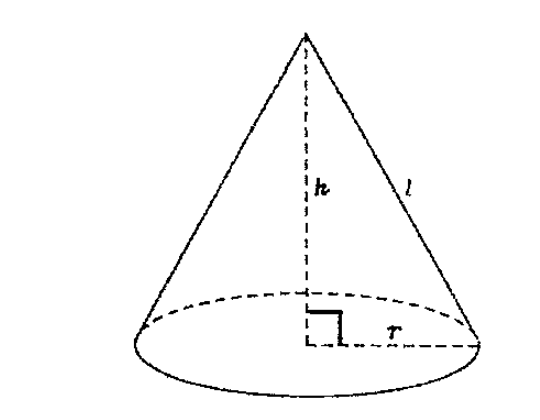
Find the center of mass of a right circular cone (as shown in the figure) of height h, radius r, and constant density.
  1. h / 4
  2. h / 3
  3. 2h / 3
  4. h / 5
  5. 2h / 5
提示
Integrate using disks of radius that shrinks linearly from the base to the apex. The centroid of a solid cone lies one-quarter of the height up from the base.
參考答案

正解:A

詳解
A. (A) h/4 — correct. Slicing the cone into disks whose radius scales linearly with height and computing z_cm = ∫z dm / ∫dm gives the centroid at h/4 measured from the base (equivalently 3h/4 from the apex). The mass concentrates toward the wide base, pulling the center of mass low.
B. (B) h/3 — incorrect. h/3 is the centroid of a triangular lamina or the volume factor (⅓πr²h), not the solid cone's center of mass.
C. (C) 2h/3 — incorrect. This is the distance from the base to the apex centroid measured the wrong way, or a confusion with 3h/4 from the apex.
D. (D) h/5 — incorrect. Too low; the integration of linearly-shrinking disks yields 1/4, not 1/5, of the height.
E. (E) 2h/5 — incorrect. This is the result for a solid paraboloid-type profile, not a cone with linearly tapering radius.

微積分(B)

求下列極限(填最終答案)。
提示
對 1 - sin x / x 在 x→0 時做泰勒展開(≈ x²/6),取對數後分析指數 ln(底)/ln x 的極限。
參考答案

正解:7.3890560989(容差 ±0.01)

詳解

設 L = limx→0+ (1 - sin x / x)1/ln x,取對數:ln L = limx→0+ ln(1 - sin x / x) / ln x。

因 sin x = x - x³/6 + ⋯,故 1 - sin x / x = x²/6 - x⁴/120 + ⋯ = (x²/6)(1 - x²/20 + ⋯)。於是 ln(1 - sin x / x) = ln(x²/6) + ln(1 - x²/20 + ⋯) = 2 ln x - ln 6 + O(x²)。

除以 ln x:[2 ln x - ln 6 + O(x²)] / ln x = 2 - (ln 6)/ln x + O(x²/ln x)。當 x→0+ 時 ln x → -∞,故第二、三項皆 →0,得 ln L = 2。

因此 L = e² ≈ 7.389056。(數值收斂很慢,因 -(ln 6)/ln x 衰減極緩,但極限確為 e²。)

提示
從已知的 eᵘ = Σ uⁿ/n!,代入 u = -x²。
參考答案

由 eu = Σn≥0 un/n!,代入 u = -x²:

e-x² = Σn=0 (-1)n x2n / n! = 1 - x² + x⁴/2! - x⁶/3! + ⋯ = 1 - x² + x⁴/2 - x⁶/6 + ⋯

收斂半徑為 ∞(對所有 x 收斂)。

提示
先化簡 f(x):令 s = t - 1,將 f(x)=∫₁^{x-1} e^{-(t-1)²}dt 改寫成 ∫₀^{x-2} e^{-s²}ds;再逐項積分 e^{-s²} 的級數。
參考答案

令 s = t - 1,則 f(x) = ∫1x-1 e-(t-1)² dt = ∫0x-2 e-s² ds。這正好以 a = 2 為中心(注意 f(2)=0)。

把 e-s² = Σn≥0 (-1)n s2n/n! 逐項積分(自 0 到 x-2):

f(x) = Σn=0 (-1)n (x-2)2n+1 / [n! (2n+1)] = (x-2) - (x-2)³/3 + (x-2)⁵/10 - (x-2)⁷/42 + ⋯

收斂半徑為 ∞。

提示
令 w = x - 2。用 (b) 的 f 級數與 arctan w = w - w³/3 + w⁵/5 - ⋯ 求分子的領導項,分母 (x-2)⁴ ln(2x-3) = w⁴ ln(1+2w) ≈ 2w⁵。
參考答案

正解:-0.05(容差 ±0.001)

詳解

令 w = x - 2 → 0。由第 2 題 (b),f(x) = w - w³/3 + w⁵/10 - ⋯;又 arctan(x-2) = arctan w = w - w³/3 + w⁵/5 - ⋯。

分子:f(x) - arctan w = (w⁵/10 - w⁵/5) + O(w⁷) = -w⁵/10 + O(w⁷)(w 與 w³ 項完全相消)。

分母:(x-2)⁴ ln(2x-3) = w⁴ · ln(1 + 2w) = w⁴ (2w - 2w² + ⋯) = 2w⁵ + O(w⁶)。

故極限 = (-1/10) / 2 = -1/20 = -0.05。

提示
對 F(x,y)=e^{x²+y}-ln(x/y²)-1=0 做隱函數微分求 y'(1);線性化 L(x)=y(1)+y'(1)(x-1)。
參考答案

設 F(x,y) = ex²+y - ln(x/y²) - 1 = ex²+y - ln x + 2 ln|y| - 1。在 (1,-1):e0 - 0 + 0 - 1 = 0 ✓,且 y(1) = -1。

偏導數:Fx = 2x ex²+y - 1/x;Fy = ex²+y + 2/y。在 (1,-1)(ex²+y=1):Fx = 2 - 1 = 1,Fy = 1 - 2 = -1。

y'(1) = -Fx/Fy = -(1)/(-1) = 1。

線性化:L(x) = y(1) + y'(1)(x - 1) = -1 + 1·(x - 1) = x - 2。即 y ≈ x - 2。

提示
用隱函數二次微分:F_xx + 2F_xy y' + F_yy (y')² + F_y y'' = 0;先算各二階偏導在 (1,-1) 的值,y'(1)=1。
參考答案

正解:10(容差 ±0.001)

詳解

由 (a) 得 y(1) = -1、y'(1) = 1,且在 (1,-1) 處 ex²+y = 1。對 F(x,y(x)) = 0 二次微分得 Fxx + 2Fxy y' + Fyy (y')² + Fy y'' = 0。

二階偏導(E = ex²+y):Fxx = 2E + 4x²E + 1/x² → 在 (1,-1):2 + 4 + 1 = 7;Fxy = 2xE → 2;Fyy = E - 2/y² → 1 - 2 = -1;Fy = -1。

代入:7 + 2·2·1 + (-1)·1² + (-1)·y'' = 0 ⇒ 7 + 4 - 1 - y'' = 0 ⇒ y'' = 10。

故 y''(1) = 10。(數值隱式求解亦驗得 ≈ 10。)

求下列定積分的值(填最終答案)。
提示
代換 x = 4 sin²θ,則 (4-x)/x = cot²θ、dx = 8 sinθ cosθ dθ,積分化為 ∫ 8 cos²θ dθ。
參考答案

正解:5.1415926536(容差 ±0.01)

詳解

令 x = 4 sin²θ,θ∈[0, π/4](x: 0→2 對應 sin²θ: 0→1/2)。則 4 - x = 4 cos²θ,(4-x)/x = cot²θ,√((4-x)/x) = cotθ;dx = 8 sinθ cosθ dθ。

被積式:cotθ · 8 sinθ cosθ dθ = 8 cos²θ dθ。

0π/4 8 cos²θ dθ = 8 [θ/2 + sin 2θ/4]0π/4 = 8 [π/8 + 1/4] = π + 2 ≈ 5.141593。

故 ∫02 √((4-x)/x) dx = π + 2。
提示
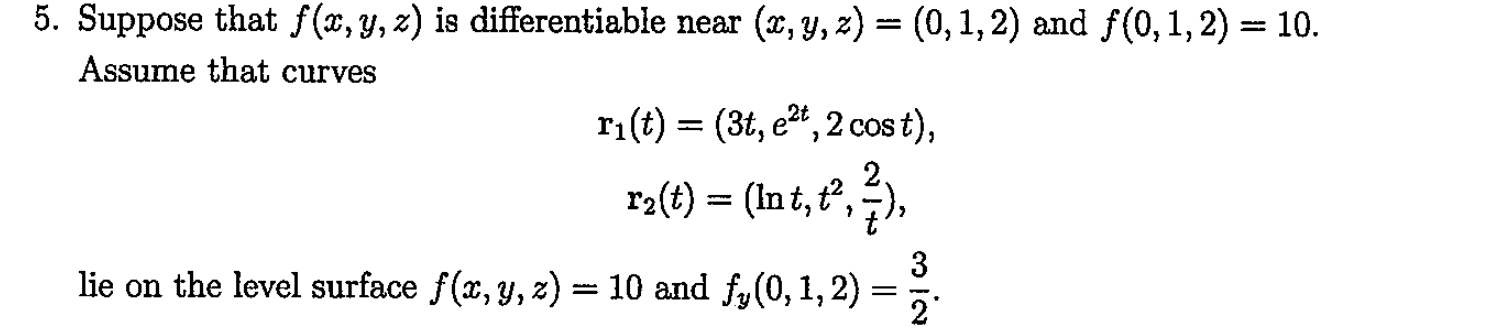
梯度 ∇f 垂直於兩條過該點的曲線切向量;用 ∇f·r₁'=0、∇f·r₂'=0 配合 f_y=3/2 解出 ∇f,再寫切平面。
參考答案

兩曲線在 P=(0,1,2) 上(r₁ 在 t=0、r₂ 在 t=1 達 P),其切向量皆與 ∇f(P) 垂直。

r₁'(t)=(3, 2e2t, -2 sin t),t=0 → T₁=(3,2,0);r₂'(t)=(1/t, 2t, -2/t²),t=1 → T₂=(1,2,-2)。

設 ∇f(P)=(a,b,c),已知 b=fy=3/2。由 ∇f·T₁=0:3a+2b=0 ⇒ 3a+3=0 ⇒ a=-1。由 ∇f·T₂=0:a+2b-2c=0 ⇒ -1+3-2c=0 ⇒ c=1。故 ∇f(P)=(-1, 3/2, 1)。

切平面:-1(x-0) + (3/2)(y-1) + 1(z-2) = 0,整理(乘 2)得 -2x + 3y + 2z = 7(等價於 2x - 3y - 2z + 7 = 0)。
提示
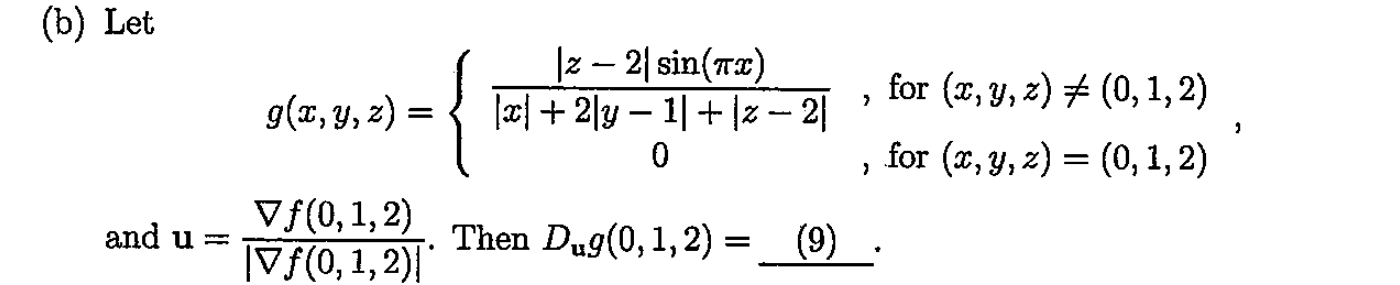
g(P)=0,故 D_u g(P)=lim_{h→0⁺} g(P+hu)/h。注意分子含 sin(πx)~πx 與 |z-2| 各貢獻一個 h,分母為 h 的一次式,最後得有限常數。
參考答案

由 (a),∇f(P)=(-1, 3/2, 1),|∇f(P)| = √(1 + 9/4 + 1) = √(17)/2,故 u = (-1, 3/2, 1)/(√17/2) = (2/√17)(-1, 3/2, 1),即 u=(u₀,u₁,u₂),u₀=-2/√17、u₁=3/√17、u₂=2/√17。

因 g(P)=0,沿 u 的方向導數 Dug(P) = limh→0⁺ g(P+hu)/h。代 P+hu=(hu₀, 1+hu₁, 2+hu₂):分子 = |hu₂|·sin(π h u₀) ≈ |hu₂|·(π h u₀) = π u₀ |u₂| h²;分母 = |hu₀| + 2|hu₁| + |hu₂| = h(|u₀|+2|u₁|+|u₂|)。

故 g(P+hu)/h → π u₀ |u₂| / (|u₀| + 2|u₁| + |u₂|)。代入 |u₀|+2|u₁|+|u₂| = (2/√17)(1+3+1) = 10/√17,u₀=-2/√17,|u₂|=2/√17:

= π·(-2/√17)·(2/√17) / (10/√17) = π·(-4/17) / (10/√17) = -2π/(5√17) ≈ -0.30478。

故 Dug(0,1,2) = -2π/(5√17) ≈ -0.3048。

提示
在 h=1 的條件極值,由 Lagrange ∇f=λ∇h 配合 h_x=6 與已知 ∇f 求 λ;最大值對約束水準的敏感度 dM/dc=λ(包絡定理),用線性近似估 c 由 1 變 0.9。
參考答案

正解:10.0166666667(容差 ±0.002)

詳解

f 在 P=(0,1,2) 處於約束 h=1 下取得最大值 M(1)=f(P)=10。由 Lagrange 條件 ∇f(P)=λ ∇h(P)。已知 ∇f(P)=(-1, 3/2, 1)(見第 8 格),且 hx(P)=6。

比較 x 分量:-1 = λ·6 ⇒ λ = -1/6。

由包絡定理,最大值 M(c)(約束 h=c)對 c 的敏感度為 dM/dc = λ。線性近似:M(0.9) ≈ M(1) + λ·(0.9 - 1) = 10 + (-1/6)·(-0.1) = 10 + 1/60 ≈ 10.01667。

故估計的最大值 ≈ 10.0167(= 601/60)。
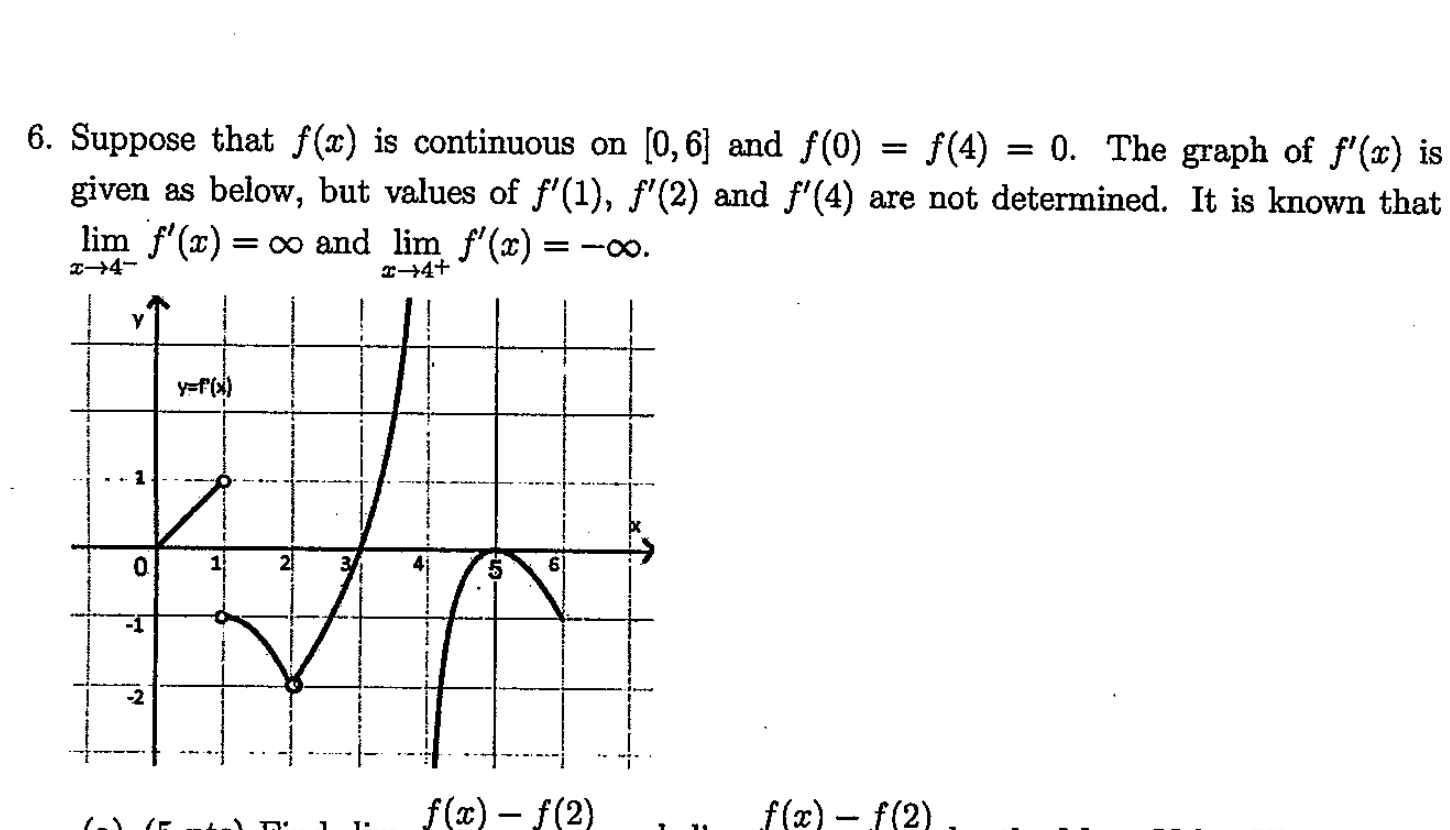
f 在 [0,6] 連續,f(0)=f(4)=0,y=f'(x) 的圖形如下(f'(1)、f'(2)、f'(4) 未定,且 limx→4- f'(x)=∞、limx→4+ f'(x)=-∞)。請依各小題作答,並寫出論證與計算。
提示
由 y=f'(x) 圖讀斜率與符號:(a) 看 x→2± 時 f' 的單側極限(差商即單側導數);(b) 臨界點=f'=0 或不存在處並判增減;(c) 凹性看 f' 的增減(f''符號);(e) lim f(x)-f(6)=∫₆^∞ f'(x)dx,用部分分式與 arctan 積分。
參考答案

讀圖(y=f'(x)):x∈[0,1] 為線段由 (0,0) 升至開點 (1,1);x=1+ 起自開點 (1,-1),下凹至開點 (2,-2)(極小)後上升,於 x=3 處過零並陡升,x→4- 時 f'→+∞;x=4+ 自 -∞ 上升,於約 x=5 附近過零,形成位於 x 軸上方的小凸起後再下降,至 x=6 約為 -1。f' 在 x=1、2 為跳躍不連續,x=4 為垂直漸近。

(a) f 在 x=2 的右導數 = limx→2⁺ [f(x)-f(2)]/(x-2);由均值定理,此差商等於某中間點之 f',當 x→2⁺ 時 f'(ξ)→ f'(2⁺)。由圖 f' 自 x=2+ 起點為 -2(開點),故右導數=-2。同理左導數 = f'(2-),由圖 x=2- 時 f'→-2,故左導數亦=-2。兩單側導數相等(皆 -2),雖 f'(2) 本身未定,f 在 x=2 仍可微,f'(2)=-2。

(b) 臨界數=f'(x)=0 或不存在之點。f'=0:x=3、以及 (4,6) 內過零點(約 x≈5 一處由負轉正、之後再由正轉負一處);f' 不存在:x=1、2(跳躍)、x=4(無界)。局部極大:f' 由正轉負處(x=1- 附近 f' 由正→1 後跳為負,故 x=1 為局部極大候選;以及 (5,6) 內 f' 由正轉負之點)。局部極小:f' 由負轉正處(x=3,f' 由負轉正;及 (4,5) 內 f' 由負轉正之點)。(依圖形精確判讀:x=1 局部極大、x=3 局部極小;x=4 因 f' 不存在但 f 連續,需逐一檢查符號變化。)

(c) y=f(x) 上凹 ⇔ f''>0 ⇔ f' 遞增;下凹 ⇔ f' 遞減。由圖:f' 在 (2,4) 遞增(上凹)、在 (0,1) 遞增(上凹);f' 在 (1,2) 遞減(下凹),(4,5) 遞增、(5,6) 遞減。反曲點出現在 f' 由增轉減或反之之處(如 x=2 附近、x=5 附近)。請依圖逐段標明。

(d) 由各區間 f' 的符號(f 增減)與大小(陡緩)描繪 f:f(0)=0,(0,1) f'>0 故 f 增;(1,2)~(2,3) f'<0 故 f 減(在 x=3 前後 f' 由負轉正,f 有局部極小);(3,4) f'>0 且趨於 +∞ 故 f 陡增;(4,?) f' 由 -∞ 回升,f 先減後依符號變化;f(4)=0 為已知定點。據此連成連續曲線。

(e) 對 x>6,f'(x) = -32/(x²+2x) - 6/(x²-6x+18)。limx→∞ f(x) - f(6) = ∫6 f'(x) dx。第一項:-32/[x(x+2)] = -16(1/x - 1/(x+2)),積分 6→∞ 得 16 ln(3/4)。第二項:-6/[(x-3)²+9],積分得 -2 arctan((x-3)/3),6→∞ 得 -2(π/2 - π/4) = -π/2。合計 = 16 ln(3/4) - π/2 ≈ -6.1737。故 limx→∞ f(x) - f(6) = 16 ln(3/4) - π/2 ≈ -6.174。
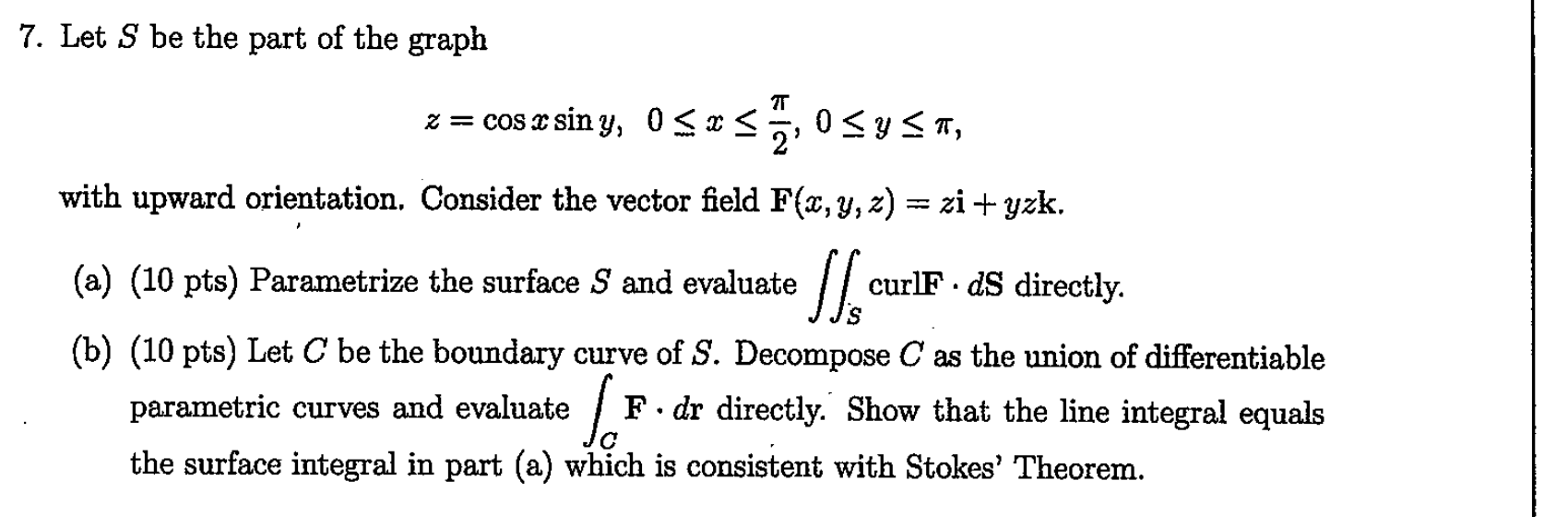
請依各小題作答,並寫出完整的參數化與計算過程。
提示
curl F=(z,1,0);對圖面 z=g(x,y) 上向法線取 dS=(-g_x,-g_y,1)dA,直接在矩形 [0,π/2]×[0,π] 上積分得 (a)。(b) 邊界曲線在 z=0 的三段貢獻為 0,僅 x=0 那段(z=sin y)有貢獻,得相同的 π/4。
參考答案

curl F:F=(z, 0, yz)。curl F = (∂(yz)/∂y - 0, ∂z/∂z - ∂(yz)/∂x, 0 - ∂z/∂y) = (z, 1, 0)。

(a) S 為圖面 z=g(x,y)=cos x sin y,(x,y)∈D=[0,π/2]×[0,π],上向。法向量元素 dS=(-gx, -gy, 1) dA,gx=-sin x sin y、gy=cos x cos y。

curl F · dS = (z,1,0)·(-gx,-gy,1) = z(-gx) - gy = (cos x sin y)(sin x sin y) - cos x cos y。

S curl F·dS = ∫0π0π/2 [cos x sin x sin²y - cos x cos y] dx dy。第一項 = (∫0π/2 cos x sin x dx)(∫0π sin²y dy) = (1/2)(π/2) = π/4。第二項 = -(∫0π/2 cos x dx)(∫0π cos y dy) = -(1)(0) = 0。故結果 = π/4

(b) 邊界 C=矩形邊界之像(逆時針,配合上向)。F·dr = z dx + yz dz。三條落在 z=0 的邊(y=0、x=π/2、y=π,因 z=cos x sin y 在這些邊皆為 0)貢獻為 0。僅 x=0 邊(y 由 π 到 0):z=sin y,dz=cos y dy,dx=0,被積式 = y z dz = y sin y cos y dy = (y/2) sin 2y dy。

∮ = ∫π0 (y/2) sin 2y dy = -∫0π (y/2) sin 2y dy。由分部積分 ∫0π (y/2) sin 2y dy = (1/2)[-y cos 2y/2 + sin 2y/4]0π = (1/2)(-π/2) = -π/4。故 ∮C F·dr = -(-π/4) = π/4。

與 (a) 的 π/4 相符,驗證 Stokes 定理。

開始刷「114 學年度臺灣大學轉學生招生考試」→ 免費線上刷題